Dr. Sándor Miskolci's Clinical Experience with the BIONIKA Bioplant BC System
In certain situations, the oro-vestibular diameter of the edentulous alveolar ridge is insufficient for the placement of conventional implants with a diameter of 4–4.3 mm or even 3.3–3.5 mm. When the patient's general condition, lack of consent, or local bone tissue characteristics preclude augmentation of the vertical diameter of the alveolar process (lateral onlay grafting, ridge splitting, or the use of expanding osteotomes), narrow-diameter implants — so-called pin implants with diameters of 2.3–2.8 mm — available from several manufacturers on the implantology market may represent a viable alternative.
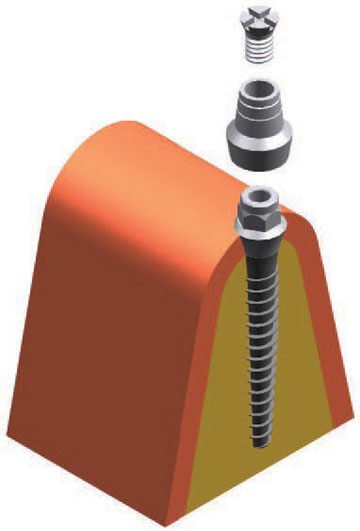
In our clinical practice, we have been using BIOPLANT bicortical (oral and vestibular) support screw implants manufactured by BIONIKA Medline Orvostechnikai Kft., with cervical diameters of 2.3 mm and 2.8 mm, for six years now — in cases of limited oro-vestibular bone availability where ridge widening is not possible for any reason. During the prosthetic use of these implants, we consistently aim to splint them — either with each other or with other implants — through cast bridge frameworks or bar-type mesostructures.
It is well established that the optimal implant-abutment connection is internal to the implant body. With this type of anchorage, an implant cervical diameter of approximately 3 mm or less carries an inherent risk of fracture. The external hex engagement required for intraoperative positioning and connection is therefore a compromise, while simultaneously — unlike similar competing products — it offers the possibility of variability. Depending on the insertion depth, the shoulder-shaped, widened implant neck — positioned either intra- or suprамucosally — transitions into a hex-based abutment post 2 mm in height, onto which various abutments can be secured with a through-screw:
- individually millable cylinder,
- tapered abutment,
- reverse tapered abutment
- ball-head retention element.
It is possible to pattern a crown or mesostructure framework directly onto this surface and to secure it either by screw retention or cementation. Additionally, the fixation screw can be replaced by a longer screw of the same diameter as the hex post (which may also be cemented in place), effectively converting the implant into a single-stage unit with an extended abutment that can be adapted and adjusted to the clinical situation. Beyond its prosthetic versatility, another major advantage of the product is that it is available in extreme lengths of 22–28 mm.
For patients whose status permits the use of extra-long implants, we indicate preoperative 3D CT imaging, followed by careful surgical planning. During the procedure, preparation of the implant socket — both pilot drilling and core drilling — is carried out with enhanced external and internal irrigation of the rotary instruments. Periimplant soft tissue healing is either subgingival or transgingival, depending on the thickness of the mucoperiosteum. Immediate, early, or delayed prosthetic loading is possible; we prefer the latter.
Case 1: The patient declined augmentation procedures; accordingly, the available bone volume and implant positions were minimally adequate. A Camlog® 3.8 × 11 mm implant was placed at position 24, and BIONIKA Bioplant Bicortical implants of varying lengths were placed at positions 15, 12, and 21, with cast post-and-shoulder caps at teeth 13 and 23. A split mesostructure (bar) was used, with support on teeth 13 and 23 provided by dental abutments only, and retention and anchorage on the implants achieved via intermediate components with removable screw retention. The overdenture was retained with 3 preci-horix attachments.
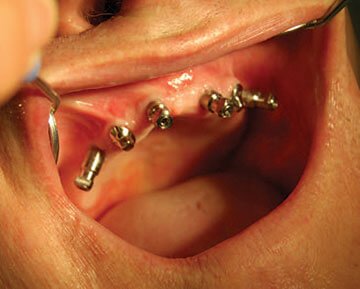
Positioning abutments prior to impression taking
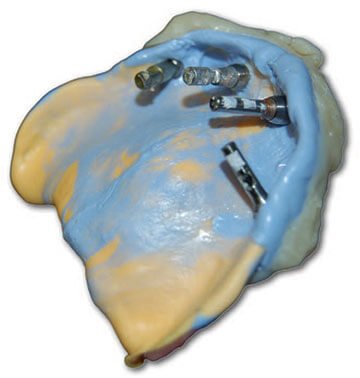
The completed impression after assembly of the intermediate components and laboratory analogues
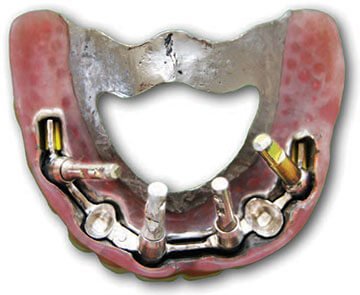
The completed prosthesis: split bar between teeth 13–11, without the central horix matrix (work by dental technician József Ajtay)
Dr. Sándor Miskolci
Specialist in Dental and Oral Diseases, Specialist in Dento-Alveolar Oral Surgery
Article information
- Author | Dr. Miskolci Sándor
- Date | 2017.01.24.
- URL | www.bionika.hu