MC Implant Abutment System (0°–75°)
The MC implant abutment system is built on a revolutionary manufacturing technology currently in the research phase. Its essence lies in the combination of a CNC machining unit with a novel special kinematics and CAD-CAM technology. This makes it possible to produce factory-manufactured angulated correction abutments with pre-designed angle orientations in the range of 0°–75°.
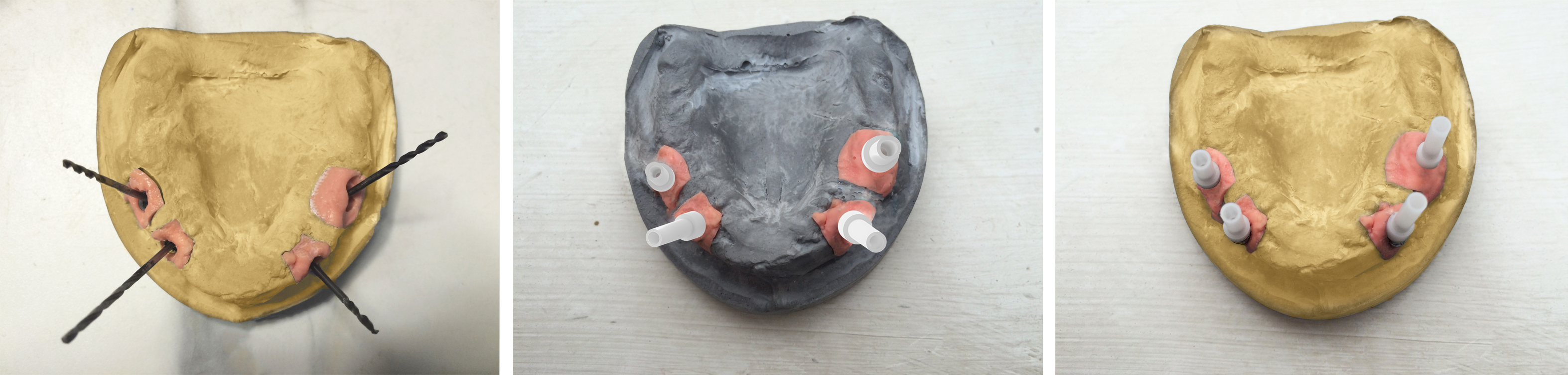
Fig. A: Directions of placed implants — Fig. B: Angle correction achievable with 30° Multi-unit heads available from other manufacturers — Fig. C: Angle correction achievable with BIONIKA MC heads currently under development
To address the problem illustrated in Figures A–B, BIONIKA launched the MC implant abutment R&D&I research and development project.
Using the BIONIKA MC product family, angular deviations between 0° and 75° can be corrected steplessly across a wide range (Fig. 2). This naturally requires the required implant correction angle to be defined in advance.
Any dental design software (e.g. Exocad) can be used to determine the angle correction, as can the patented mechanical angle-measuring instrument developed by BIONIKA specifically for the MC System, shown in Fig. 1. The BIONIKA MC angle gauge represents an important innovation: while other manufacturers typically offer plastic selection models to help users determine the tilt angle of different angled heads, the BIONIKA approach differs fundamentally. The various measured angle values are entered sequentially into the manufacturing software, and based on this information, a machine with the appropriate capabilities is able to produce individual MC heads — even of different sizes — one after another, entirely without human intervention. This allows highly precise, custom implant abutments to be manufactured efficiently using factory technology in the 0°–75° range, with or without a crown, within a 24-hour turnaround time.
The basic types of MC abutments are illustrated in Figures 2 and 3. These geometric forms exist, but cannot yet be produced on demand with freely selectable angles, quickly, precisely, and with productive factory technology at any stepless angle deviation.
This high-precision parallelisation of implants has become increasingly necessary in today's practice, driven by the growing use of screw-retained prostheses, in order to ensure precise assembly.
The MC R&D&I research and development project of BIONIKA Medline Orvostechnikai Kft. is focused on the following product types.
1. MC Straight and Angulated Abutments for Cemented Prostheses
For cemented crowns and bridges, the abutment taper is ideally a 3°–5° self-locking cone. If their axes are not manufactured with adequate parallelism, significant stresses can develop in the prosthesis, even though the cement layer can compensate for certain deformations. For the longevity of the prosthesis, it is critical to use factory-produced MC-type solutions.
2. MC Ball Head and Locator Head for Removable Prostheses
Various types of attachment heads (e.g. ball heads, locator heads) are very commonly used for the temporary fixation of removable prostheses. The most common approach for this purpose is the use of straight heads, for which the ball cap and locator insert allow a correction of 5°–10°. However, this requires the relative positions of the implants to not deviate significantly from those angle values, which means long-lasting, high-quality solutions are not always achieved.
The MC system ensures the necessary angle correction between 0° and 75° when using ball heads, locator heads, and all other attachment heads.
3. MC Screw-Retained Abutments for Removable Prostheses
Screw-retained prostheses demand the highest level of precision to achieve a stress-free, well-fitting, long-lasting removable denture. Despite the many potential failure points, their use is justified in cases where treatment protocols require the periodic removal of the fixed prosthesis. Fig. 3 illustrates the options available with screw-retained prostheses in the 0°–75° angular range.
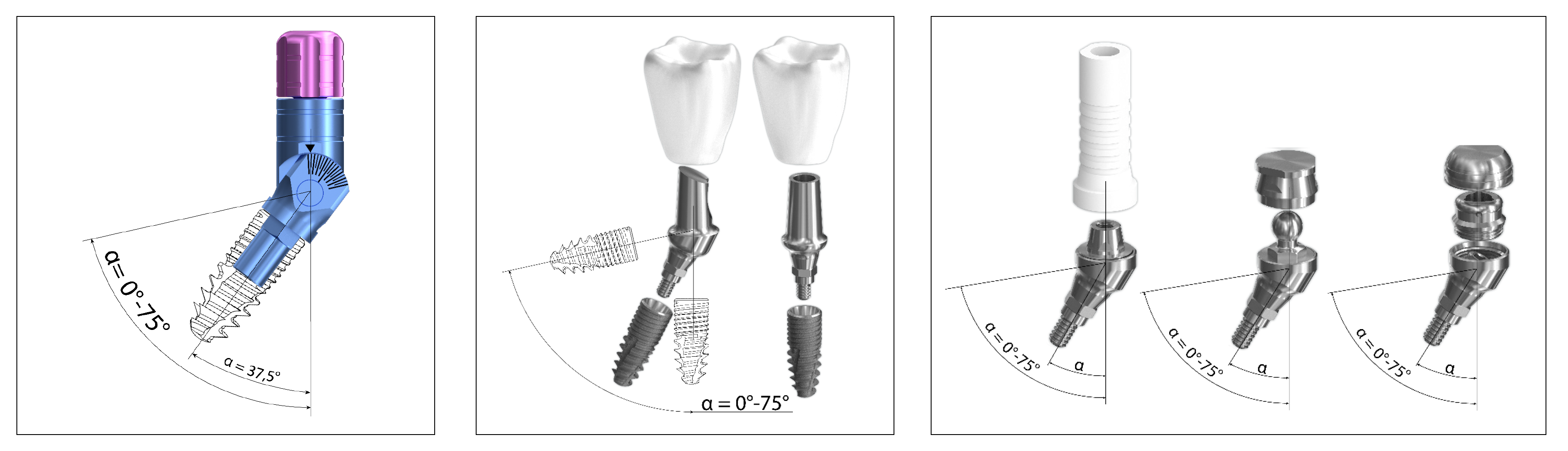
Fig. 1: MC angle-measuring head — Fig. 2: MC straight and angulated grindable abutments — Fig. 3: MC multi-unit, ball head, and locator head abutments
4. Summary
A key issue in dental technology is that abutments placed in implants must always be precisely parallel to the denture. What sets the MC system apart from other solutions is that competitors typically manufacture abutments at specific fixed angles — such as 17° and 30° Multi-Unit heads — whereas BIONIKA, using the MC abutment system, is able to produce abutments at any angle steplessly within the 0°–75° range. In brief, this is the essence of the latest research and development project of BIONIKA Medline Orvostechnikai Kft.
We would like to take this opportunity to express our gratitude to all of our partners who support our work with their ever-new ideas and medical expertise, helping us create ever more perfect solutions for our patients.
Article information
- Author | Hajdú József
- Date | 2018.10.28.
- URL | www.bionika.hu