Mini Hybrid Implant, the New Direction
The “X”-Cross Implantation
With versatile, interchangeable abutments, the Hybrid system offers a complex, multi-functional solution tailored to your individual needs for cases suitable for mini implant-supported prosthetics. One-piece and two-piece, immediately loadable, extra-narrow, standard and extra-short ball-head, locator-head, tapered, and multi-unit Hybrid implants provide a wide range of applications for prosthetic restorations in plastic, zirconia, titanium, and cobalt-based materials.
- Versatility matters more than size, yet the Hybrid system is unrivalled in its size range as well. A new, personalised direction in implantology. The manufacturer’s R&D innovation system guarantees the most optimal, individually tailored size selection — even on a per-patient basis. Your patient is not a mass-produced item. You design the customised implant for them. We simply guarantee its conformity in accordance with the ISO EN 13485 standard mandatory for medical devices.
- Intelligent implant system. The manufacturer continuously follows and incorporates all scientific advances — from classical principles to the most modern concepts — and integrates research that maximises the efficiency of clinical practice, beyond addressing patient needs.
- Unique Biomimitek technology. Intelligence matters more than brute force, yet through BIONIKA’s “Biotis” surface integration technology, the Mini Hybrid implant is exceptionally outstanding in primary stability and unmatched in osseointegration.
- Total-function abutment system — including solutions that currently exist only in your imagination, provided they are achievable with today’s technology. The freedom of biological adaptation is yours, as is the success. You can follow your patient’s jawbone anatomy for implantation in good conscience.
- The Hybrid system holds the answer. The manufacturer contributes to your greater success with the Hybrid through effective developments, innovations, professional support, and service, making it outperform any other product.
- Guaranteed warranty — meaning the manufacturer guarantees implant replacement even when warranty conditions are not met. The Hybrid pays for itself regardless. A timeless investment.
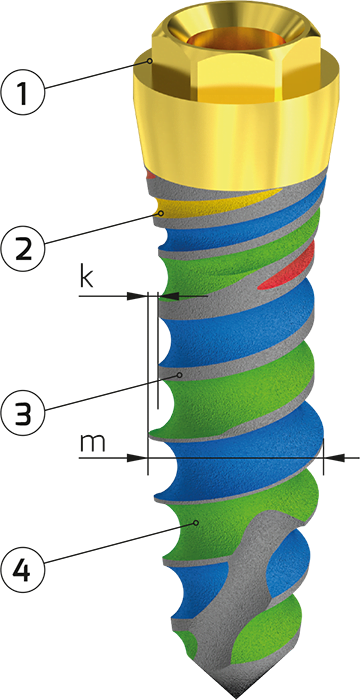
Structural components of the Hybrid implant body:
1. Branemark-type hexagonal cross-section head with internal cone and thread.
2. Micro thread structure with four-lead cortical rope thread.
3. Two-lead standard rope-threaded body section for dampening dynamic force loads.
4. Cycloidal thread structure with increased contour and thread depth providing primary stability, with self-tapping edge and anti-rotation groove.
The principal general characteristic of the BIONIKA Hybrid implant system is that, in analogy with nature, every element of the thread has a radial profile with a continuously varying cross-section. The rope-threaded screw section (marked 3) has a smaller diameter — indicated by “k” — than the apical section (marked “m”), which features the sharper cycloidal thread designed to ensure primary stability.
Application areas of the Hybrid implant
Patients with limited bone volume are increasingly common, and they naturally wish to fully restore the function of their dentition. To address this, BIONIKA developed the Hybrid implant system, which enables the fabrication of versatile prosthetic restorations even for these patients.
Removable prostheses
When a patient has no remaining teeth, a complete prosthetic restoration can be provided. In such cases, one option is a removable denture. Typically, 2–4, or in the case of the upper jaw up to 6–8 implants are placed, taking into account bone quality and load-bearing requirements. The ball-head solution can already be considered a classic and is the most widely used retention option. The Hybrid mini system includes implants with both 1.8 mm (micro) and 2.5 mm (standard) diameter ball heads. A 2.3 mm diameter (medium) ball head can also be ordered to individual specification.
As a unique service, BIONIKA also produces so-called corrected-size ball heads, depending on the required retention force. Comparatively newer is the use of single-piece or two-piece mini implants with a locator or torus-shaped head. These provide greater stability to the denture with fewer implants. A major advantage of the Hybrid solution is the replaceability of worn ball heads and locator heads.
Bar-retained removable dentures
In addition to the implants, a custom-made metal bar can also be placed, screwed onto the implants, providing even greater support and stability to the prosthesis. The bar is fixed to 2–6 implants. This distributes the load on the implants more evenly, thereby extending their lifespan.
In bar-retained cases, both the clinician and the dental technician have the option of designing and fabricating the prosthesis so that the ball head or locator head is positioned not along the implant axis, but at the optimally chosen position on the bar. Implant-supported denture retention brings a significant improvement in quality of life even for removable prosthetic patients, as the denture becomes far more stable than conventional removable dentures or those retained with denture adhesive. It delivers a sense of perfection both in chewing and in speech.
Article information
- Author | Hajdú József
- Date | 2016.03.29.
- URL | www.bionika.hu
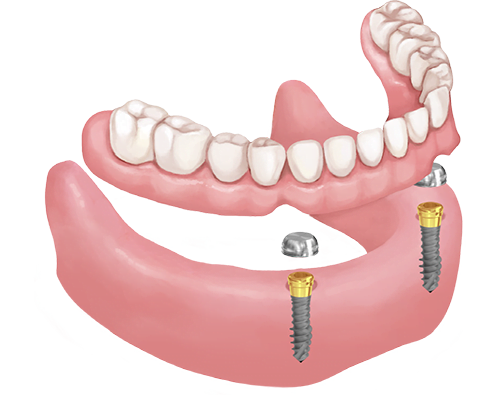
Fig. 2: Locator-head denture retention with Hybrid implant, interchangeable locator head
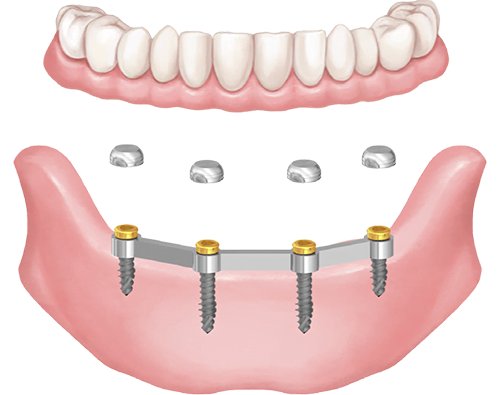
Fig. 3: Bar-retained locator-head retention on 4 Hybrid Implants with screw-retained superstructure
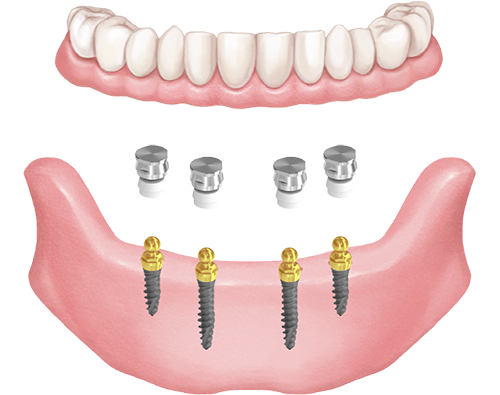
Fig. 4: Denture retained on Hybrid Implants with interchangeable ball heads
Advantageous solutions with mini Hybrid implants
Optimum — the cost-effective solution on 4 implants
With this approach, even narrow Hybrid mini implants are suitable for fabricating high-stability prosthetic restorations. A provisional denture can be placed on the same day as surgery. Immediate improvement in function, speech, and aesthetics. Treatment times can be shorter and costs lower compared to conventional implant treatment methods.
Safe concept — the secure solution
With the placement of 6 implants, the Safe concept further increases prosthesis stability. This is particularly advantageous in cases of high masticatory forces. The use of longer implants allows for greater bone-to-implant contact area, thereby avoiding the need for bone augmentation. Favourable bone level for tilted and axial implants. High implant survival and osseointegration rates.
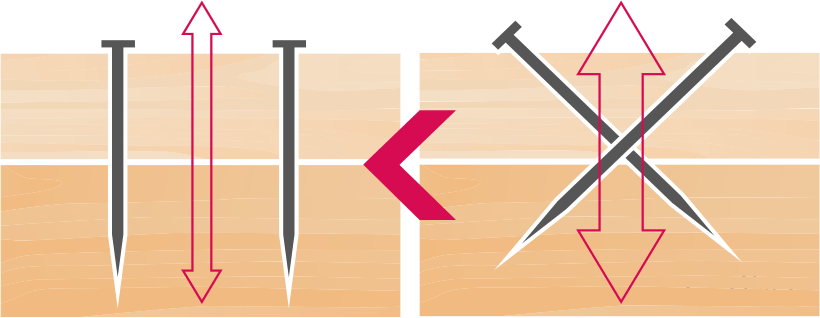
Fig. 5: Diagram explaining the load-bearing capacity of retention elements as a function of insertion direction
X Cross-Implantation
A German dentist colleague drew my attention to the long-forgotten technology of goose-nail stapling. On his suggestion, we began developing the Hybrid implant system with the goal of finding a solution for patients with limited bone volume who require high-load-bearing prosthetic restorations. The accompanying illustration clearly explains to everyone the load-bearing capacity of goose nails as a function of the direction of insertion.
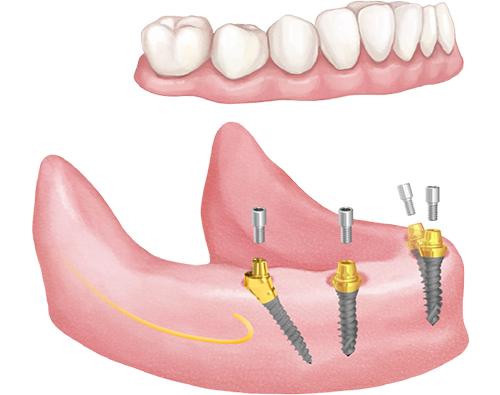
Fig. 5:
Optimum concept — with 4 implants
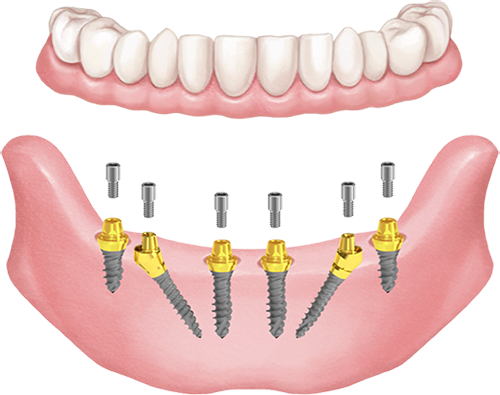
Fig. 6:
Safe concept — with 6 implants
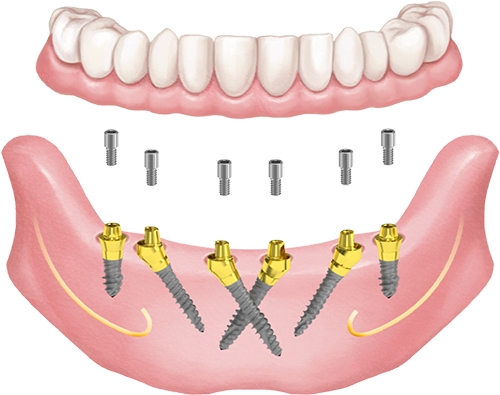
Fig. 8:
X-Cross-Implantation
The thread diameters of the narrow Hybrid mini implants were designed to allow cross-directional insertion even in cases of limited bone volume. This is why the central thread section has a narrower design.
A well-executed X Cross-Implantation solution significantly redistributes the force patterns generated within the jawbone and promises results of high stability.