The stability meter
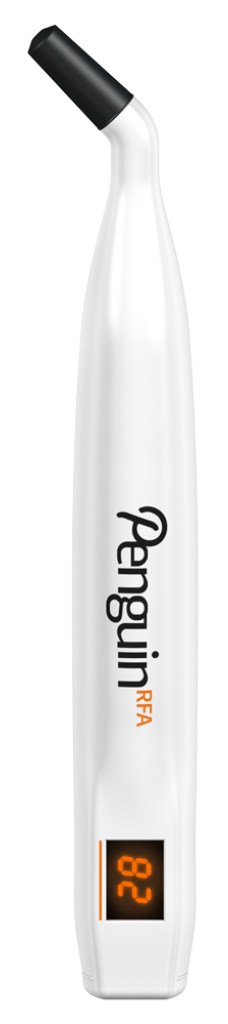
Penguin RFA
An innovative device that helps measure and verify implant stability reliably and affordably.
Cutting-edge technology
The Penguin uses resonance frequency analysis (RFA) to measure stability.
Accurate data
Dentists can obtain accurate ISQ values to assess osseointegration.
Against the risks
This is especially useful for patients with compromised bone quality.
How the device works
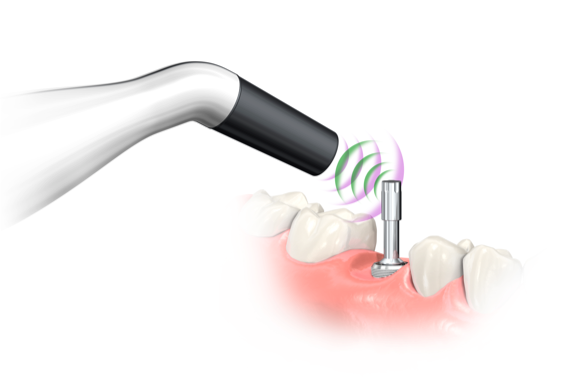
Activating and using the device is extremely simple. As a first step, press the black control button; once two dashes appear on the display, the device is ready to use. Held near the head of the MulTipeg screwed into the implant, the signal from the instrument's tip induces magnetic resonance in the MulTipeg. The device senses this, and the result is the ISQ value displayed within seconds.
It is advisable to always take at least two measurements. We can provide a MulTipeg head for most titanium and ceramic implants.
Steps for using the device
Step 1: Select the appropriate MulTipeg measuring head.
Step 2: Using the driver, screw the MulTipeg head into the implant with 6–8 Ncm torque.
Step 3: Turn on the device and hold it close to the top of the MulTipeg measuring head.
Step 4: The instrument emits a beep when it starts measuring, and another sound when the ISQ value appears on the display.
The device's measurement results
Using magnetic resonance measurement, the stability meter evaluates implant stability, expressed in the so-called ISQ (Implant Stability Quotient). The measurement result on the 0–100 ISQ scale shows the degree of primary stability and osseointegration. The ISQ value can be interpreted as follows:
- ISQ value above 70: indicates high stability
- ISQ value between 60–69: indicates medium stability
- ISQ value below 60: indicates low stability
The greatest advantages of the Penguin RFA
- Easy-to-use, reliable device.
- Its use can shorten the time to the final restoration.
- Provides accurate ISQ measurement results.
- Available at a much more favourable price than competing ISQ devices.
- Can be used with great success even for high-risk patients (diabetic and cancer patients, smokers, osteoporosis and other bone diseases, elderly patients, etc.).
More information about the device:
It is advisable to use the stability meter twice per patient: first when the implant screw is placed, and second before the final restoration is fitted.
According to the recommendations, each MulTipeg head — which contains a magnetic head section using vibration technology — can be used 20 times.
For more details, take a look at our publications!