Special Cases at the DentCAM Milling Centre!
Since the establishment of the BIONIKA DentCAM Milling Centre in 2016, we have encountered numerous requests, including cases that initially seemed impossible to solve. Thanks to our experienced and skilled specialists, however, we have found a solution for every case — to the great satisfaction of our partners. In this article, we present the most remarkable work we have undertaken.
Case 1 – Tooth and Gingiva Restoration in One Step
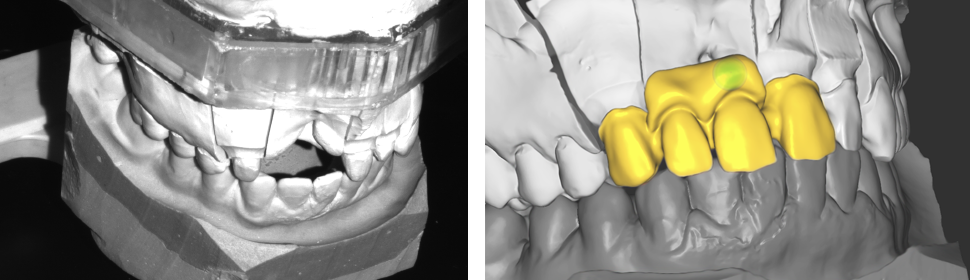
A young man's upper dentition was severely injured as the result of a serious accident. A surgical procedure was performed during which a section of bone was removed from the maxilla. This was not replaced, which meant the patient also required gingival restoration, incorporated into the prosthesis. The first image shows that replacement of teeth 11 and 12 together with the interdental papilla in the anterior region was necessary. Our dental technician scanned the model shown in the image and began designing the dental prosthesis using dedicated CAD software.
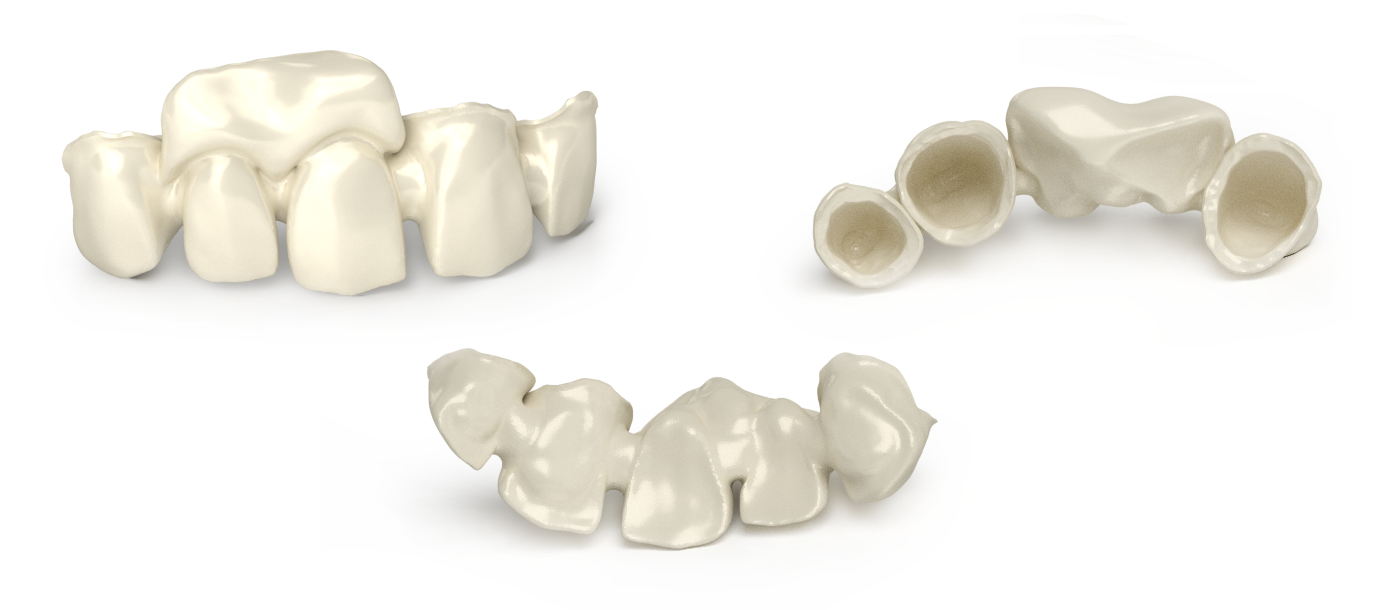
The following images show the completed prosthesis design from the labial, internal, and palatal views.
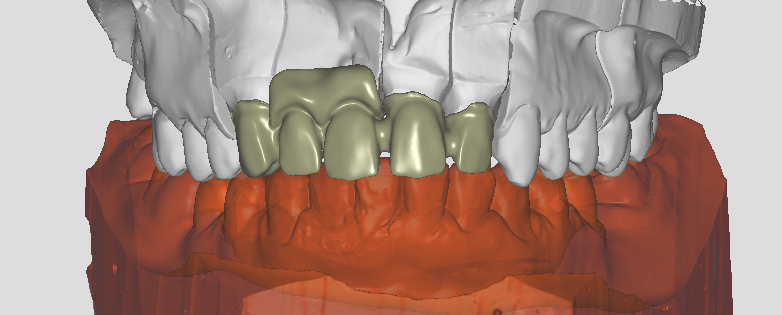
The next image shows the completed prosthesis on the model. After the design phase, we milled the framework from zirconia using a 5-axis dental milling machine, followed by sintering. The finished framework was then handed over to our partner, who only needed to apply the anatomical ceramic veneer — allowing them to focus solely on achieving perfect aesthetics, to the full satisfaction of the patient.
Case 2 – Full Zirconia Full-Arch Bridge in "Goliath" Dimensions
This case was brought to us by one of our dental technician partners. An elderly female patient had an above-average mouth size and wished to receive a full-arch bridge restoration, but many laboratories had declined the job.
This apparently "unsolvable" case then came to us. Once we received the plaster model, we scanned it and proceeded to design the complete prosthesis framework.
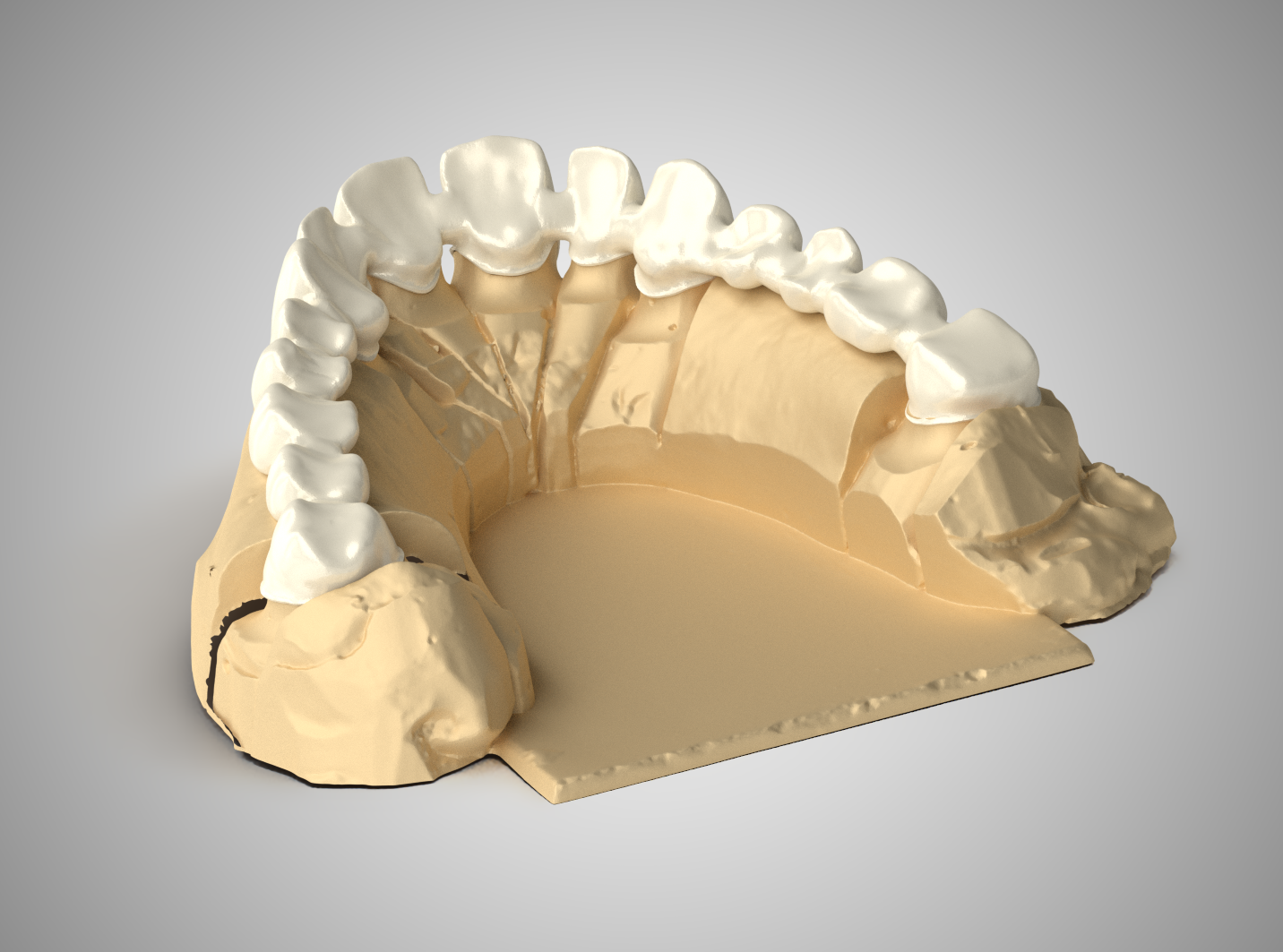
After fabrication, the bridge barely fit inside the sintering furnace. Distortion during sintering is a common problem, so in this case we paid particular attention to preventing warpage in order to ensure proper fit. The full-arch bridge was fabricated from zirconia and subsequently delivered to our partner for veneering.
Case 3 – Multi-Unit Screw-Retained Prosthesis
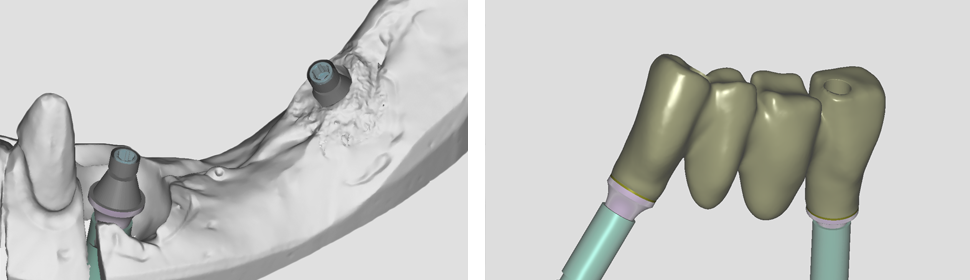
We received a multi-unit wax-up model from one of our partners. The patient had two implants and wished to have a bridge restoration fitted on them. The images show the scanned dental model with the BIONIKA UNIFORM (Compatible) AC technical implant and the multi-unit head screw inserted.
Bridge with Preci-Vertix Telescopic Attachments
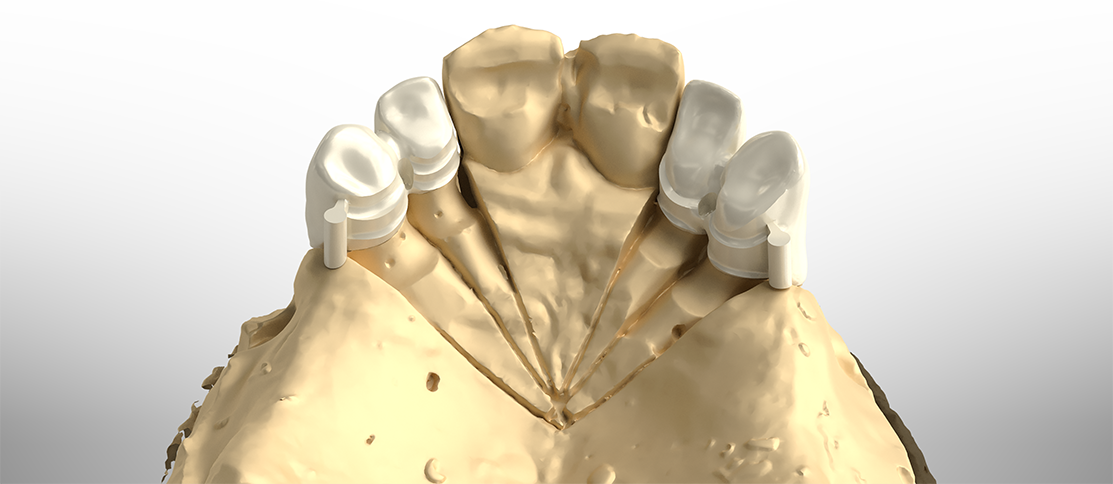
The primary component of a combined prosthetic restoration for a metal-sensitive patient was fabricated from zirconia (two 2-unit bonded bridges with Preci-Vertix telescopic attachments). The attachments are parallel to each other so that the secondary component (the removable part) fits precisely and without tension.
Custom Abutments for Prosthetic Frameworks
In addition to standard solutions, custom abutments can be designed for prosthetic restorations. We are able to produce compatible abutments for the implant systems used in Hungary.
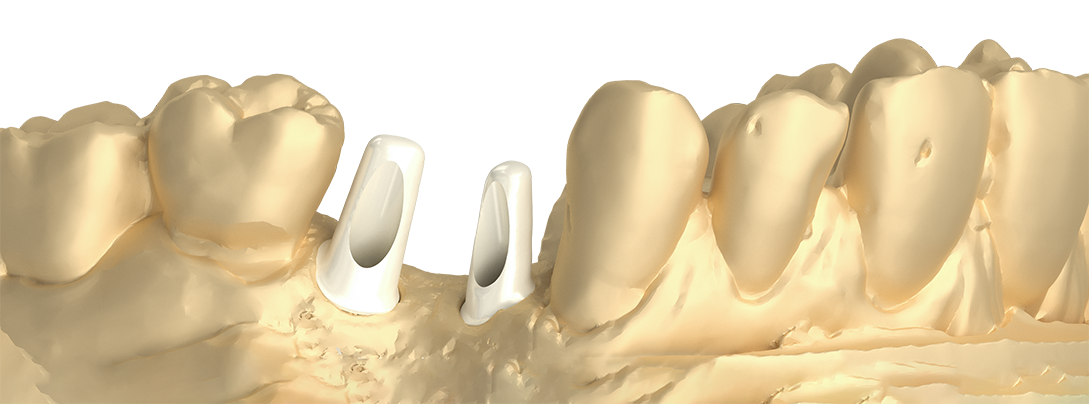
We are also open to innovation and can realise our partners' bespoke concepts. One such development is a zirconia cap that can be fixed onto a titanium base, onto which a crown can then be fabricated in the conventional manner, from zirconia. The image series above shows the zirconia cap from various angles.
For implant-supported restorations, we recommend the use of angle-correcting anatomical abutments.
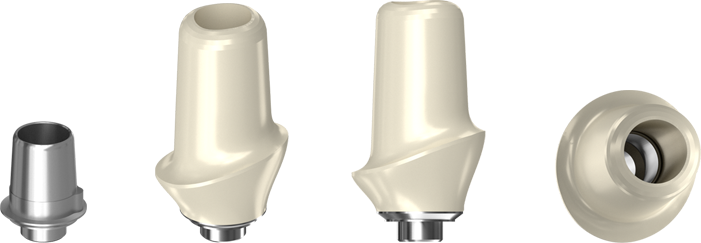
These abutments are individually designed to match the scanned plaster model, following the gingival contour around the implant. The image shows a custom-designed gingival-contoured, hex-connection abutment. When multiple abutments must be placed side by side, they must be positioned in parallel, as shown in the images.
In such cases, the finished prosthesis can be cemented without any grinding of the abutment heads. The angle-correcting anatomical abutments are fabricated from zirconia.
BIONIKA DentCAM Milling Centre
In contemporary dental trends, prosthetic frameworks produced using 3D digital technology are becoming increasingly widespread. For dental laboratories that have not yet adopted CAD/CAM technology for the fabrication of restorations, maintaining profitability can be challenging due to the high costs of transition. It was to address this challenge and to assist with seemingly unsolvable cases that we established the BIONIKA Milling Centre.
Our specialists can fabricate prosthetic frameworks from titanium, zirconia, Co-Cr alloy, and wax, based on submitted plaster models or STL files. For the completed framework, you can select from more than 60 abutment geometries in our product range. This means you only need to focus on achieving perfect aesthetics — leave everything else to the BIONIKA Milling Centre! As an implant manufacturer, BIONIKA is your partner for everything from high-volume production and custom or even unknown abutment fabrication through to design and prosthetic framework production.
If you are facing a challenge in your work or require a custom solution, we offer expert consultation at the following phone number: +36 70 670 6875 or send us a message at info@bionika.hu.
Article information
- Author | Hajdú József
- Date | 2024.05.02.