Teledentistry
What is it used for and how does it work?
Teledentistry is an online dental service that enables patients and dentists to conduct real-time video consultations without being physically present at the same location.
It gained widespread popularity during the COVID-19 pandemic due to its numerous advantages, including cost and time savings as well as greater convenience for both parties. Although remote dental care has its limitations, it can be an effective tool for dentists and patients who require dental services from a distance.

For a successful teledentistry practice, dentists must establish a close doctor-patient relationship and choose a telecommunications solution that meets clinical requirements and data protection regulations. Patients must be properly informed of the benefits, drawbacks, and limitations of online consultations. Dentists must adhere to guidelines and procedures regarding informed consent, privacy, and confidentiality. Although remote care has its limitations, it can nonetheless be an effective tool for dentists and patients who require distant dental services.
The healthcare system is undergoing rapid change driven by advances in technology and telecommunications. Telemedicine, a branch of telehealth, uses communication networks to provide healthcare facilities and medical education in regions with limited access and resources. Teledentistry, a sub-branch of telehealth, uses information technology to deliver remote dental care, consultation, and education. It was first studied in 1994 under the U.S. Army’s Total Dental Access Project. Teledentistry is used in three main ways: consultations between dentists, real-time video conferences between dentists and patients at remote locations, and remote patient monitoring. These solutions contribute to the expansion of dental health knowledge and facilitate effective information exchange between patients and dental professionals, which can lead to improved treatment outcomes. Real-time video conferencing is the preferred method of teledentistry, offering advantages over simple mobile consultations. However, to meet the growing demand for online video conferences, improving technical infrastructure and careful patient selection are essential. Establishing a doctor-patient relationship and adhering to appropriate guidelines during online consultations are of fundamental importance. Overall, teledentistry appears to be a promising solution for both dentists and patients.
Technologies used in teledentistry
Teledentistry, enabled by advances in information and communication technology (ICT), is revolutionising oral healthcare worldwide. It facilitates communication between patients, dentists, and specialists for diagnostic and treatment purposes. Two main types of interaction can be distinguished in teledentistry. One type involves pre-recorded media, encompassing so-called asynchronous systems, while the other involves “real-time” or synchronous systems.
The store-and-forward system used in teledentistry enables clinical information, including images, to be stored in a virtual repository for use as diagnostic references and treatment plans. It also serves as a valuable tool for patient counselling, even for remote patients. Dentists and specialists can easily exchange patient information, images, and health-related data, and seek the opinions and advice of other specialists when needed. Such systems typically function well even with low-bandwidth internet connections.
Real-time teledentistry methods involve video calls or conferences between the dentist, specialists, and the patient. This interactive approach allows them to quickly review clinical and general information, medical history, radiographs, and laboratory findings to reach a diagnosis. Real-time image and information exchange improves the clinician’s understanding and enhances communication with the patient.
Remote patient monitoring is a novel feature of telemedicine that allows dentists and clinical experts to collect detailed health information directly from patients’ homes and transmit it to clinical centres. The primary benefit is a reduction in healthcare costs. In addition, mobile communication devices such as smartphones and tablets have become valuable tools for public health education and promotion.
Applications of teledentistry
In diagnosis:
Teledentistry offers numerous significant benefits, including minimising inequalities in healthcare access, improving patients’ access to professional advice, reducing treatment time without compromising quality, and dramatically decreasing waiting times. It enables easy access to oral diagnosis and treatment. Teledentistry plays a critical role in the early detection of malignant oral lesions, leading to faster treatment interventions and improved efficacy and safety of oral cancer therapy. It facilitates communication between dentists and specialists, enhancing the accuracy of remote diagnosis, particularly when multiple specialists are involved in the diagnostic process.
In oral and maxillofacial surgery:
Earlier research has demonstrated that teledentistry is effective for consultation, patient assessment, treatment planning, and follow-up care in oral and maxillofacial surgery. Patients and dentists greatly appreciate teledentistry via telephone appointments across various patient categories, particularly when in-person assessment is challenging, such as in cases of temporomandibular disorders, salivary gland conditions, head and neck cancers, and orthognathic surgery. Studies have shown overall positive feedback from both dentists and patients, with high acceptance in trauma cases but lower acceptance in temporomandibular joint disorders. While most dentists are satisfied with teledentistry, some express concerns about its effectiveness due to the limitations of physical examination, which can result in incomplete diagnoses.
In orthodontics:
Teledentistry is becoming increasingly popular in orthodontics, enabling remote consultations and monitoring for patients through virtual methods and artificial intelligence-based treatment assessment using photographs or videos. It is particularly useful for initial orthodontic consultations, treatment evaluation, and minor orthodontic emergencies, as it reduces the need for in-person visits and provides convenience and cost-effectiveness. However, certain procedures that require direct access to the oral cavity cannot be performed via teledentistry, and challenges remain in acquiring adequate data to maintain the quality of on-site consultations.
In restorative dentistry and endodontics:
Endodontics is a specialised field of dentistry practised by endodontists. Teledentistry can play a decisive role in delivering endodontic care to underserved patients. Highly trained endodontists can remotely assist general dentists in identifying root canal orifices by providing guidance and instructions via telephone. Teledentistry using the internet as a communication medium has proven effective in diagnosing periapical lesions of anterior teeth, offering the dual benefit of reducing costs and increasing access to emergency care for remote patients.
In paediatric dentistry:
Children’s oral and dental health significantly affects their overall health and well-being. Paediatric dentists can utilise advances in information and communications technology to serve their patients and promote better oral hygiene habits. Teledentistry enables preventive telephone consultations, the sending of dietary charts by e-mail, and the introduction of online dental hygiene resources. It may be particularly helpful for paediatric patients with delayed tooth eruption or other developmental issues. The primary advantage of teledentistry is the elimination of in-person visits; however, the cost of smartphones or computers may present a challenge for some patients.
The dentist-patient relationship
Mutual trust is fundamental in the dentist-patient relationship, where the dentist requests the necessary information and the patient agrees to the terms of treatment. This agreement must be based on mutual consent and must include specific rules governing the conduct of online consultations. Since there may be a disparity in medical knowledge between dentists and patients, dentists must provide sufficient information regarding the benefits and drawbacks of online consultations.
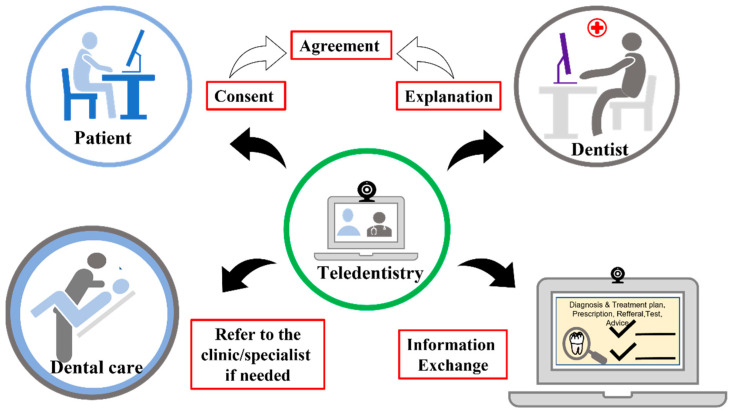
Teledentistry: the dentist-patient relationship
Source: Islam et al. (2022)
The greatest advantage of teledentistry for patients is the convenience it offers, the reduction of long waiting times, and improved access to healthcare — particularly in areas where dental services are less readily available. It is important to note that not all dental problems can be managed remotely. Where necessary, in-person consultations must be used to determine the most appropriate course of treatment for a given patient.
BIONIKA is happy to develop new solutions together with you, including applications of artificial intelligence.
Contact us:
References:
8. Islam, R., Islam, R., Ferdous, S., Watanabe, C., Yamauti, M., Mohammad Khursheed Alam and Sano, H. (2022). Teledentistry as an Effective Tool for the Communication Improvement between Dentists and Patients: An Overview. [online] 10(8), pp.1586–1586. doi:https://doi.org/10.3390/healthcare10081586.
Article information
- Author | Hajdú József
- Date | 2023.08.01
- URL | www.bionika.hu