The Antidote to Broken Screws
Screw Retrieval Instrument Kit
e-BIONIKA News
Over the past decades, dental implants have become the most popular solution for tooth replacement. They have superseded dentures and bridges thanks to their high success rate, predictability, and the relative rarity of complications.
Abutments (screws) serve as the connecting elements of three-part implant systems, anchoring to the jawbone. The threaded portion of this fixation component is tightened until it reaches its desired final position. Osseointegration — the bonding of living jawbone with the implant — is critical to the successful healing of dental implants. Although implant treatment is one of the safest methods of tooth replacement, screw fractures can compromise the procedure. In this e-BIONIKA News article we address the problems that may arise and their solutions.
How Can a Fixation Screw Lead to Implant Failure?
Screws can fracture and remain lodged in the patient's jaw for both biological and mechanical reasons. Their removal can pose considerable challenges.
Biological Issues
Screw fractures arising from biological causes can generally be divided into two categories: those occurring within the first six months following implant placement and those manifesting thereafter.
Early failures can be triggered by a number of factors, including infection, micro-movement of the screw resulting from inadequate fixation, or premature loading.
A significant proportion of late failures present as peri-implantitis — a condition we have previously described — characterised by the gradual loss of supporting bone due to infection or inflammation.
Mechanical Issues
Mechanical problems arise primarily as a consequence of occlusal loading. This loading can occur due to a range of factors — many of which are patient-dependent.
Broken or fractured screws arising from either of the two categories described above are more readily retrievable from the implant when the fragment protrudes beyond it, as noted by Yilmaz et al. (2011). The portion remaining inside the implant, however, is regarded differently, and Gooty et al. (2014) stated:
"A fractured fixation screw can present a serious problem, as the fragment remaining inside the implant may prevent the implant from functioning correctly. A specialised instrument must be developed to retrieve it."
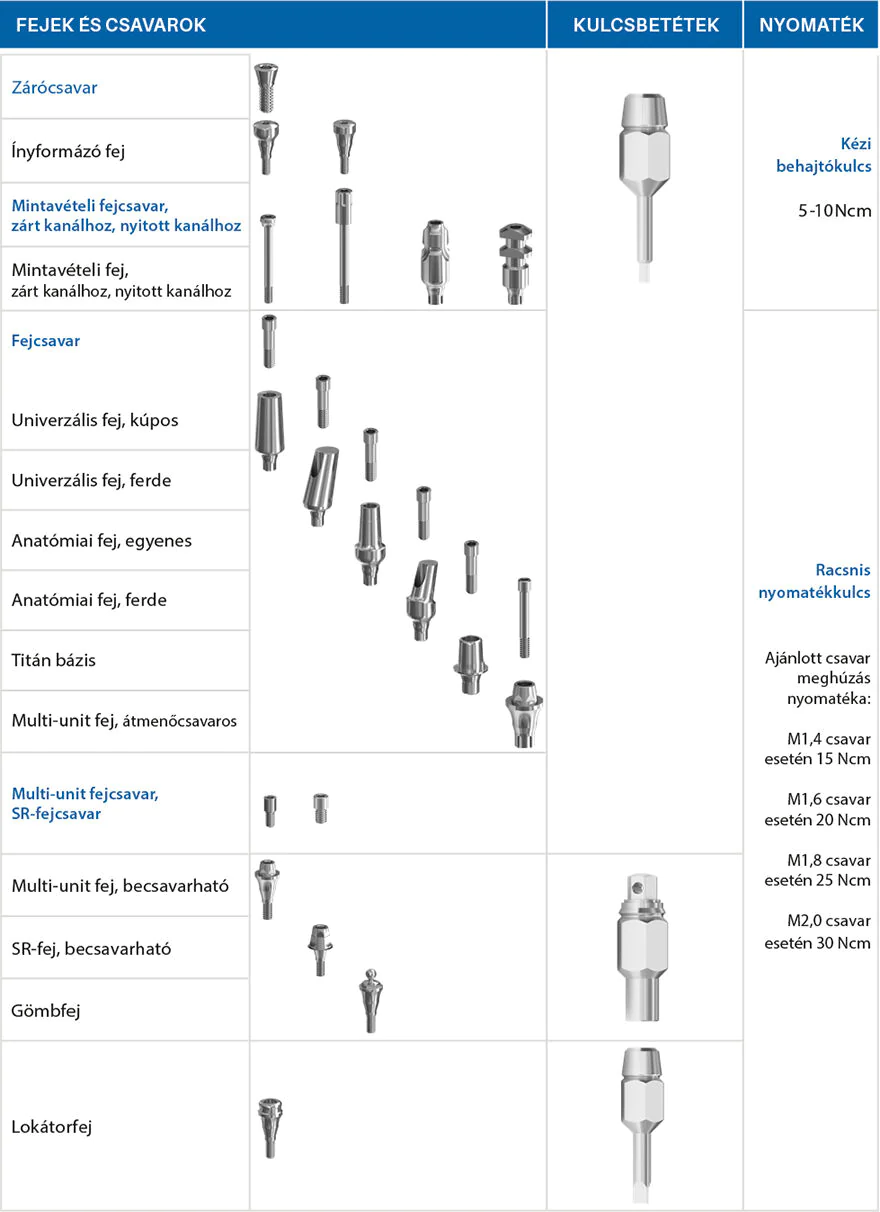
There is one fundamental solution: prevention. The most appropriate tool for preventing screw fractures is a torque wrench; with its proper use, this type of failure can be virtually eliminated. We have also prepared a reference table to assist you:
BIONIKA Solution I. – Prevention
BIONIKA Solution II. – Treatment
To address this challenge, both the theoretical and practical worlds have embarked on development efforts, and various technologies have been devised with varying degrees of success.
BIONIKA, however, taking into account the needs of dental professionals and with the utmost care, has developed its innovative screw retrieval kit — a solution that holds its own from the simplest to the most complex cases.
THE BIONIKA SCREW RETRIEVAL KIT – SIMPLE YET BRILLIANT!
Article information
- Author | Hajdú József
- Date | 2022.02.07.
- URL | www.bionika.hu