The Road to the Future!
A Case Study in BIONIKA Digital Dental Technology
The rapid advancement of digital technology in recent years has revolutionised the fields of dentistry and dental technology, opening new horizons in the design and manufacture of dental prostheses and other dental devices. The adoption of intraoral scanners, CAD/CAM systems, and 3D printing has significantly transformed traditional workflows, enabling more precise, faster, and more cost-effective solutions.
Background of the Case
A female patient presenting with missing teeth at positions 35 and 36 was referred to Dr. Tibor Skapinyecz, a practising dentist in Miskolc. Following the acquisition of panoramic X-ray and CT images, implantation was carried out. Two CORTILOG PCL implants were placed in the lateral region of the mandible — a member of the CORTILOG implant family developed and manufactured by BIONIKA. The CORTILOG PCL implant encompasses five different diameters (∅3.3, ∅3.8, ∅4.3, ∅5.0, ∅6.0), making it suitable for use with average, narrower, and wider bone volumes alike. The flat platform, the tube-in-tube connection, and the three anti-rotation cams are all features that have made this member of the CORTILOG Implant System particularly popular.
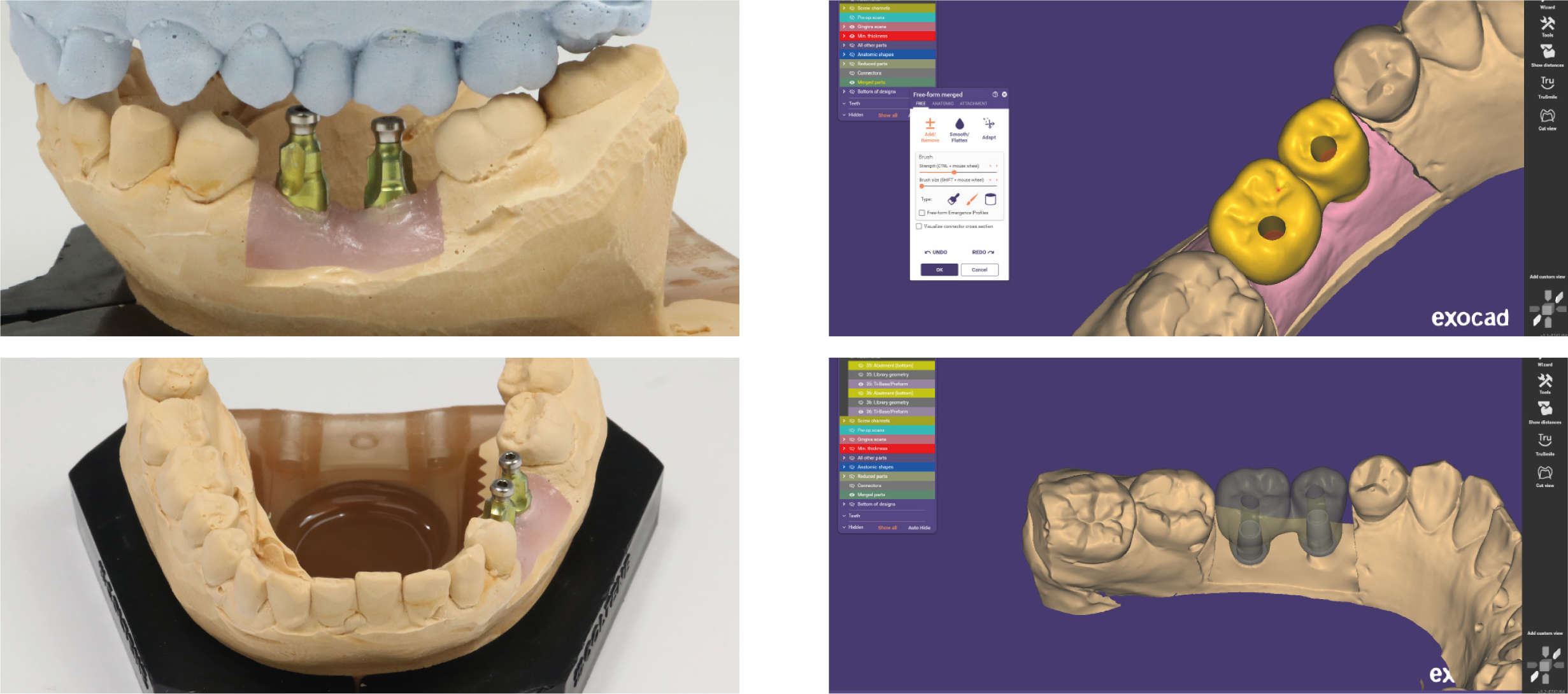
For ease of handling, two screw-retained crowns were designed for the implants. Impressions and model fabrication were carried out using an analogue procedure. Once the plaster models arrived at the BIONIKA Milling Centre, our dental technician began designing the prosthesis. BIONIKA-developed and manufactured titanium bases were used in the process. In Exocad, after selecting and refining the appropriate geometry library and tooth shapes, occlusion had to be set as precisely as possible, as anatomical tooth forms were being produced. Following the design phase, the finished STL file was imported into PreForm software; supports were positioned while avoiding surfaces with active functional areas, after which fabrication could commence.
3D Printing at the BIONIKA Milling Centre
The prosthesis was manufactured on a Formlabs Form 3 resin 3D printer using Permanent Crown Resin, also a Formlabs product. Permanent Crown Resin is a tooth-coloured, ceramic-filled, biocompatible photopolymer resin used to 3D-print permanent crowns, inlays, veneers, and in- and onlay restorations. This material offers numerous advantages: its high strength provides long-term stability, while its aesthetic properties give restorations a natural appearance. Thanks to its low water absorption and smooth surface, prostheses made from Permanent Crown Resin are less prone to ageing and discolouration, and resist plaque accumulation. They retain their aesthetic appearance and hygienic condition over the long term. The material is available in shades A2, A3, B1, and C2 according to the VITA shade guide. In this patient's case, shade A2 was used.
Following printing and a 10-minute isopropyl alcohol wash, the material was polymerised in accordance with the technical instructions — a step during which it attains its biocompatibility. The fine white layer formed during polymerisation was removed using 50-micron glass beads at 2 bar pressure. Next, the connection points of the BIONIKA titanium bases were inspected. Since 3D printers have difficulty rendering concentric circles, the surface had to be carefully refined with a diamond bur, avoiding the platform. Once the crowns fitted successfully onto the abutments, occlusion was checked and fine-tuned. A further bead-blasting cycle then followed to create a more uniform surface finish. The crowns were subsequently polished to achieve their final gloss. As a last step, ultrasonic cleaning and steam cleaning were performed, followed by drying and a final polymerisation cycle. The completed crowns were placed onto the titanium bases, which were then screwed into the implants.
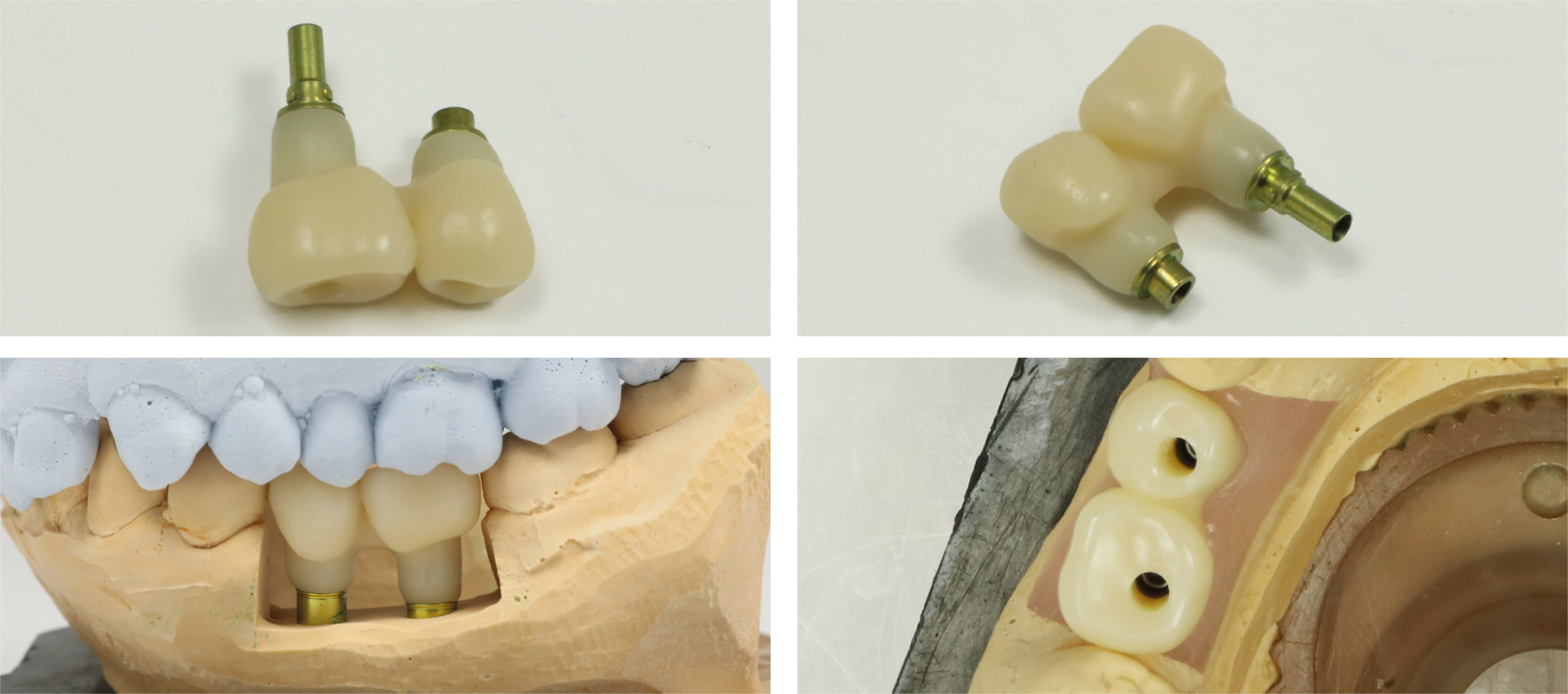
Since then, the patient has been using her new prosthesis with great satisfaction, and it has significantly improved her everyday comfort. She can once again enjoy her favourite foods without any difficulty whatsoever.
Digital Solutions at the BIONIKA Milling Centre
BIONIKA recognised the potential of digital dentistry as early as 2016 and has continuously integrated it into the services of the DentCAM Milling Centre over the years. With the latest technologies and digital solutions at our disposal, and supported by a professionally skilled, dynamic team, we welcome orders across the full spectrum of dental technology. The guiding principle of our DentCAM Milling Centre is the precision afforded by CAD/CAM technology. Computer-aided design and manufacturing (CAD/CAM) systems enable dental technicians to design and fabricate a wide range of crowns, bridges, screw-retained restorations, and temporary prostheses based on digital impressions of patients' teeth and oral structures.
The 3D printing technology employed at the Milling Centre enables the direct production of prostheses and dentures from digital designs. We place particular emphasis on staying current with the latest developments and application possibilities in the field. To this end, our team members regularly attend professional training courses to confidently master and apply new technologies. Entrust us with the fabrication of your dental restorations and enjoy the convenience and quality that modern technology has to offer. Try our services today!
Article information
- Author | Hajdú József
- Date | 2024.07.25
- URL | www.bionika.hu