Wide Range of Abutments for Screw-Retained Prostheses
Today there is a wide variety of methods available to successfully replace missing teeth. The era of the conventional removable denture is drawing to a close. Patients who have the option increasingly prefer fixed prosthetic restorations. When it comes to implant-supported prostheses, patients can choose from an equally broad range of solutions. In addition to removable and cemented restorations, it is now possible to secure crowns or bridges to the implant fixture using screws. A screw-retained prosthesis offers an easy-to-clean, stable, and aesthetically pleasing solution — exactly what every patient desires.
I developed the Scandrea implant system as an evolution of our earlier BIONIKA Cortical system, driven by a personal need to address my own edentulism. Today it not only restores my own chewing function and quality of life, but serves a large number of patients as well — at least in my view, it represents the best construction available.
As a mechanical engineer, I built the system on constructional principles established in industrial practice — breaking with the implant design philosophies most commonly applied at the time — while fully meeting rigorous medical requirements, and at the same time ensuring precise manufacturability and practically simple prosthetic workflows for broad clinical use.
In this article I present the range of abutments available at BIONIKA for the fabrication of screw-retained prostheses, illustrated through the Scandrea system.
BIONIKA's product catalogue includes many different abutment types for screw-retained restorations; however, selecting the right one can be a challenge even for the most experienced clinicians and dental technicians.
Multi-Unit Abutments
For screw-retained prostheses, Multi-Unit abutments are among the most widely used abutment types. They can also be applied in angulation-correction cases and cover the majority of clinical situations. In general, we recommend this solution for screw-retained prostheses.
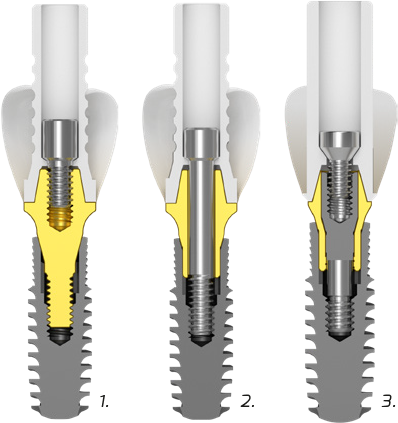
We distinguish several types:
1. Screw-in Multi-Unit Head
2. Through-Screw Multi-Unit Head
3. Dual-Screw Multi-Unit Head
1. Screw-In Multi-Unit Abutment
Screw-in Multi-Unit heads are ideal for multi-unit bridges or full-arch edentulous cases. They are threaded into the implant using a Multi-Unit key, and the finished prosthesis is then secured to them with an abutment screw.
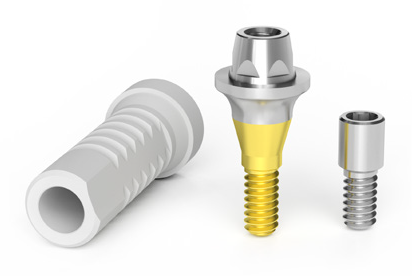
A distinctive feature of BIONIKA Multi-Unit abutments is that they are available in two taper angles.
a. 20° for parallelisation of divergent implants.
b. 40° for parallelisation of more severely divergent implants.
The abutment is threaded into the implant with adequate torque using a BIONIKA Multi-Unit key, eliminating any risk of micro-movement. Once the Multi-Unit abutment is in place in the mouth, soft-tissue-level impressioning can proceed using an impression coping that fits the Multi-Unit taper, available in open-tray and closed-tray configurations. Following the impression, the abutment remains in position to stabilise the soft tissue, and is covered with a healing cap until the prosthesis is completed. The kit also includes a temporary head for the Multi-Unit, available in titanium or high-strength plastic, for use with temporary restorations. For fabricating cast crowns and bridges on a Co-Cr framework, a burnout plastic head is available; it accommodates both straight and paracentral (PCT) screw channels, enabling angulation from 0° to 30°.
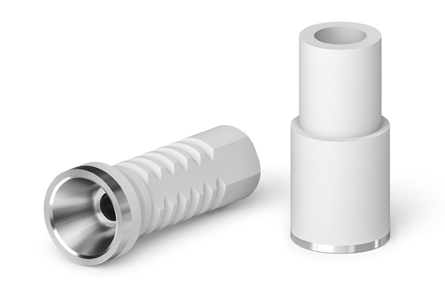
The preferred variant of the wax-up heads is the Co-Cr base head, which eliminates casting inaccuracies and ensures a precise fit of the prosthesis to the Multi-Unit taper, since the base is manufactured using industrial production technology.
Wax-up patterns with Co-Cr base heads can be invested and cast: after burnout of the plastic component, the cast metal fuses with the base, resulting in a homogeneous metal structure with a precise fit. Screw retention of zirconia crowns and bridges on Multi-Unit abutments is most commonly achieved by milling, and in most cases they can be screwed directly onto the tapered interface of the Multi-Unit head. American clinical experience shows that even when the mating surface of the most precisely fabricated zirconia bridge is thoroughly polished, micro-movements cause significant damage to the prosthesis over time. It is therefore strongly advisable to incorporate a cemented metal insert that ensures metal-to-metal contact at the interface.
2. Through-Screw Multi-Unit Head
The through-screw Multi-Unit head can be used for single crowns, multi-unit bridges, or full-arch edentulous cases. It is ideal for screw-retained restorations supported by 4 or 6 implants, particularly when the prosthesis is fabricated from metal. The prosthesis is connected to the abutment by a single long Multi-Unit retaining screw. With zirconia bridges, two important concerns arise. The first is the question of how many Ncm of torque can be applied to the long through-screw that spans the entire assembly. The second concerns the effect of micro-movements on screw loosening and wear. Some opinions hold that zirconia — due to its brittleness — must not be loaded beyond the force exerted by a screw tightened to 15–20 Ncm. Some specifications, however, permit tightening to 30 Ncm. These differing views likely stem from the use of zirconia blocks from different manufacturers for the prosthetic framework, as well as from a lack of experience in structural dimensioning. Screw loosening caused by micro-movements can also be advantageously managed with this system by incorporating a cemented metal element into the zirconia framework.
3. Dual-Screw Multi-Unit Head
In the dual-screw Multi-Unit configuration, the prosthesis and the abutment are secured to the implant using 2 screws. The screws are tightened to different torque values, which reduces the likelihood that micro-movements will disrupt the connection between the head and the implant, thereby preventing complications in the surrounding soft tissue or bone structure.
The Multi-Unit head is first fixed to the implant with the longer retaining screw at 30 Ncm torque. The second screw connects to a thread purposely formed in the head section of the previously inserted through-screw. This secures the prosthesis to the Multi-Unit abutment at a lower torque — always less than the first screw — specifically 15 Ncm. For zirconia restorations, this approach is the most appropriate.
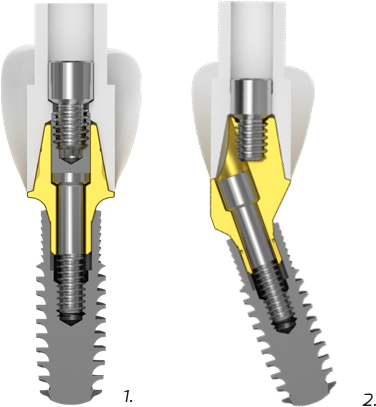
Multi-Unit abutments are also available in angled configurations. They are generally supplied with 17° and 30° angulation correction, but variants of 15°, 20°, 25°, and 35° can also be manufactured on request. A typical application is screw-retained implant-supported prostheses on 4 implants. Angled abutments also generally operate with two screws. The head can be torqued onto the implant at the specified force for the through-screw. For a metal bridge we apply 25 Ncm; for a zirconia bridge, 15 Ncm is used to fix the prosthesis. Annual check-up is strongly recommended. Advantage: even in cases of significant angulation correction, a reliable and cost-effective prosthesis can be retained on tilted implants.
Special Multi-Unit SR Heads
A special Multi-Unit design — the SR Head — was developed specifically for the Scandrea implant system.
It has since become available for all other BIONIKA systems as well. Its main distinguishing feature compared to the standard Multi-Unit is that the head profile geometry has a greater height dimension. As a result, the crown or bridge screwed onto it can withstand higher oblique loading forces (the prosthesis does not tip off the head as it can with low-taper abutments). This means that lateral forces are not borne by the screw alone.
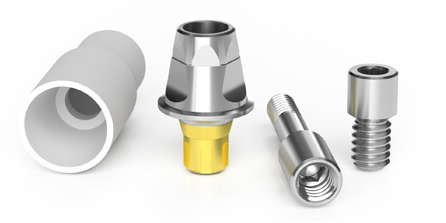
Its range of application is influenced by the available vertical space. It offers a significant advantage for single-unit crowns, two-unit, and three-unit bridges. Like standard Multi-Unit heads, it is also available in positioned and non-positioned versions, as well as in straight and angled configurations.
Summary
We can provide a wide variety of abutments for screw-retained prostheses. These may differ in diameter, length, and geometry, since as an OEM manufacturer any custom solution is possible. Our primary goal is to ensure that every clinician can apply the prosthetic method best suited to their needs, while we supply the abutment that provides the appropriate stability and fit. BIONIKA is your partner in implantology!
If you are stuck on a case or require a custom solution, we offer a free technical consultation service at the following number: +36 70 670 6875, or send us a message at info@bionika.hu!
Article information
- Author | Hajdú József
- Date | 2018.10.05.
- URL | www.bionika.hu