Virtual and Augmented Reality in Dentistry
e-BIONIKA News
Researchers and practitioners have been exploring virtual reality for decades. In 1997, Adrienn Galambos attempted to define the concept of VR in a thesis submitted to the Faculty of Humanities at the University of Miskolc. She argued that as many disciplines exist, so many different definitions would be appropriate — a view she explained by the differing objectives of scientific disciplines:
Strategic research, for instance, may develop VR tools for military applications, while pedagogy may focus on devising innovative methods for use in education.

Virtual reality in dentistry. Source: Dentistry IQ.
Early conceptions, as expressed in the column Filmvilág: Szép új világkép, described it thus:
"By 'Virtual Reality' we mean the digitally generated image projected onto our retina, based on a given programme, together with the totality of the perceptual experience it evokes."
As a supplementary reference, we would mention the HVG multimedia mini-dictionary, which conceived of virtual reality as a computer on whose screen we play.
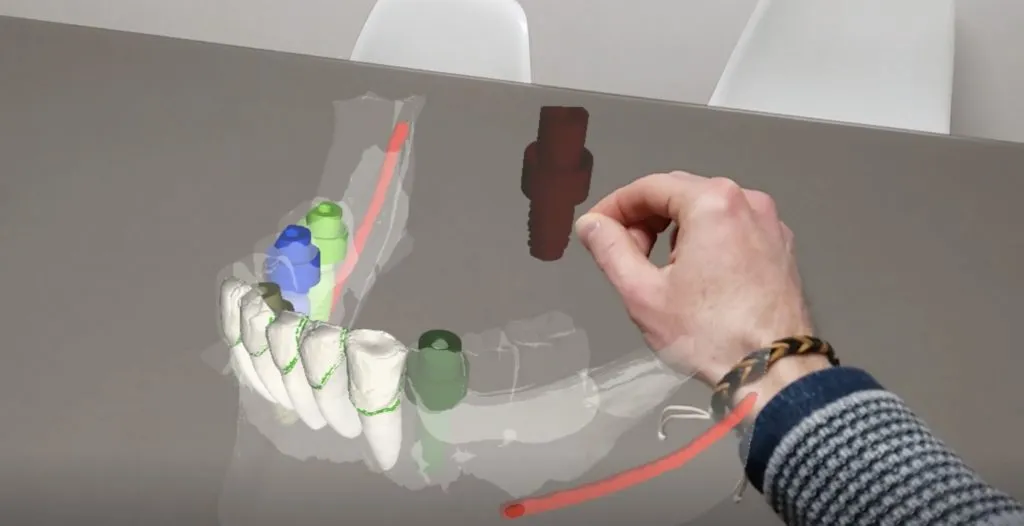
Augmented reality in dentistry. Source: Holo Dentist
In augmented reality (AR), three-dimensional virtual objects are integrated in real time into a three-dimensional real-world environment. AR overlays virtual imagery onto real space, presenting an augmented view of that space rather than the physical environment alone. It is simpler than it sounds: this is how you try on glasses online, or how you can place IKEA furniture anywhere in your own home using your smartphone.
Virtual reality and augmented reality are already being used to train bomb disposal experts, pilots, and — not least — practising dentists.
This week we explore how VR and AR work in the context of dental practice and what application possibilities they offer. At the end of the article we have included a comment section where you are welcome to share your experiences!
Virtual and Augmented Reality in Dentistry
Huang et al. (2018) noted that the growing demand for dental implants makes the adoption of new technologies in dental education increasingly important. In their view, this technological advancement will play an ever greater role in both surgical and educational training processes.
The table below compares various simulation training systems based on Roy (2017):
| PerioSim | CDS | DentSim | IDEA | Simodent | |
| Ergonomic posture | No | Yes | Yes | No | Yes |
| Immediate feedback | No | Yes | Yes | Yes | Yes |
| Examination scenario | Yes | Yes | Yes | No | Yes |
| Tooth used | Animated | Animated | Plastic | Animated | Animated |
| Left and right side operation | Available | Available | Available | Available | Available |
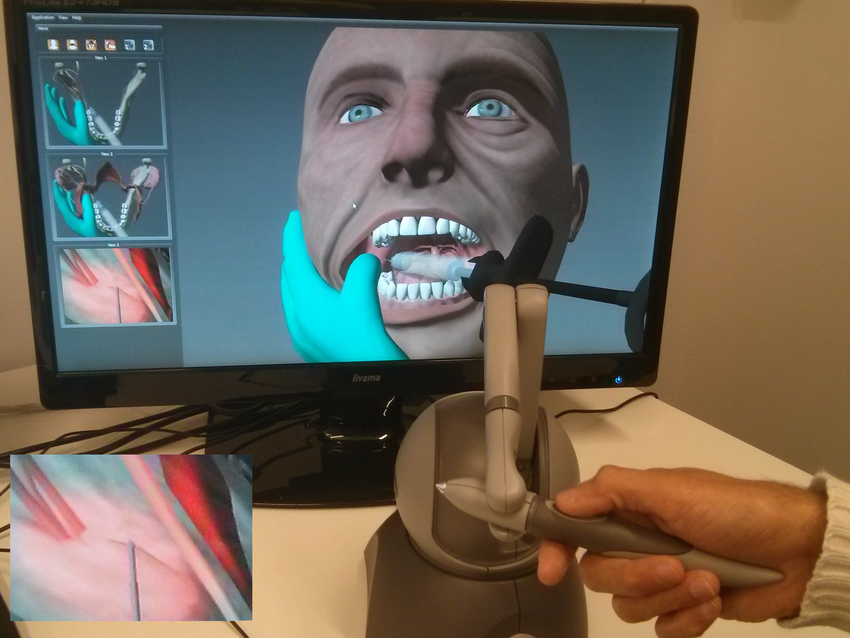
New types of simulations are available in many forms — as computer games, as patient profiles assembled through social networks, as virtual reality simulators, or even as computers capable of replicating fine grips and movements, such as the cutting of plastic teeth. There are also devices that provide tactile feedback. Such innovations not only protect patients from anxiety about being treated by less experienced practitioners, but also give new generations of students the opportunity to maintain their interest in the field.
Bogár et al. (2020) summarised the advantages for students, instructors and institutions compared with traditional teaching:
| Advantages for students | Advantages for instructors | Advantages for institutions |
| Opportunity for risk-free practice | Repeatable cases | Cost-effectiveness |
| Exposure to rare and high-risk conditions and cases | Modularity: teaching at undergraduate and postgraduate levels | Educational organisational advantages in clinical teaching |
| Building confidence and reducing stress levels | Opportunity for objective assessment and standardisation | Significant marketing factor and positive effect on student satisfaction |
| Development of non-technical skills (communication, teamwork, empathy, etc.) | Convenience factors (equipment, controlled environment, etc.) | Quality assurance |
Overall, simulation technology is best classified into 5 levels according to its degree of advancement.
Level Zero
At this level, students use written simulation, working with pen and paper. Printed images are used to enrich the simulation. Teaching typically takes place in a classroom setting and represents the least realistic level.
Level One:
Instruments are illustrated using 3D models during the simulation, though this format is rarely realistic. It is suitable for practising individual tasks and uses a clinical teaching room in addition to the standard classroom.
Level Two:
At this level, simulations are displayed on screen, combined with software, videos, and digital media. This constitutes the virtual reality level, which — in addition to the demonstrative purpose of Level One — also becomes suitable for the development of cognitive skills.
Level Three:
A standardised patient simulation in which students interact either with real patients or with trained patient actors who participate in role-play scenarios. Its disadvantage is that it can only be used with small groups; however, the level of realism is exceptionally high.
Level Four:
Advanced patient simulator: computer-controlled, programmable devices, typically full-body. As programming and a thorough knowledge of the software are required, this is considered one of the more complex solutions.
Level Five:
Interactive patient simulators: computer-controlled, full-body, interactive simulators ("HIFI" — high-fidelity — simulators).
The range of outcomes achievable through such simulation is highly diverse:
Cognitive skills, patient management, interpersonal skills, physical examination, diagnostics, interventional procedures, and comprehensive healthcare delivery.
In Hungarian institutions providing simulation-based training, teaching is delivered primarily by clinical specialists employed at universities who also engage in patient care. In smaller hospital centres, training is provided by the specialists of the respective institution.
University centres are located in Debrecen, Pécs and Szeged, while there are 17 teaching hospitals across the country, including those in Tatabánya, Eger, Miskolc, and others.
References:
Huang, T., Yang, C., Hsieh, Y., Wang, J. and Hung, C. (2018). Augmented reality (AR) and virtual reality (VR) applied in dentistry. The Kaohsiung Journal of Medical Sciences, [online] 34(4), pp.243–248. Available at: https://www.sciencedirect.com/science/article/pii/S1607551X1730815X [Accessed 25 Mar. 2023].
Poyade, M., Lysakowski, A. and Anderson, P. (2014). Development of a Haptic Training Simulation for the Administration of Dental Anaesthesia based upon Accurate Anatomical Data. Eg.org. [online] Available at: https://diglib.eg.org/handle/10.2312/eurovr.20141353.143-147 [Accessed 25 Mar. 2023].
Bogár, P.Z., Tóth, L., Rendeki, S., Mátyus, L., Németh, N., Boros, M., Nagy, B., Nyitrai, M. and Maróti, P. (2020). Az egészségügyi szimulációs oktatás jelene és jövője Magyarországon. Orvosi Hetilap, [online] 161(26), pp.1078–1087. Available at: https://akjournals.com/view/journals/650/161/26/article-p1078.xml [Accessed 25 Mar. 2023].
Article information
- Author | Hajdú József
- Date | 2023.03.21.
- URL | www.bionika.hu